
Contents
- 1 The Evolution of the Haunt Ticketing Platform
- 2 Mastering Revenue with Dynamic Pricing AI
- 3 Predictive Analytics for Ticket Sales
- 4 Revolutionizing Queue Management Technology
- 5 AI Marketing: Beyond Basic Email Blasts
- 6 Enhancing Security and Safety with AI
- 7 The Role of Contactless and Self-Service Solutions
- 8 Choosing the Right Haunt Ticketing Platform
- 9 The Future of AI Haunted Houses and Immersive Tech
- 10 Operational Efficiency and Staff Management
- 11 Final Thought: Embracing the Digital Transformation
Running a successful haunted attractions has evolved far beyond creative scares and elaborate set designs. While the heart of the haunt remains the thrill, the backbone of the business is now driven by sophisticated technology. For haunt attraction owners and event organizers, the administrative load of managing crowds, sales, and marketing can be as terrifying as the monsters inside the attraction. The integration of an AI ticketing platform is revolutionizing how the industry operates, turning chaotic queues and unpredictable revenue streams into streamlined, data-driven success stories.
The modern event booking system does more than just sell a ticket. It acts as a comprehensive operational hub. By leveraging artificial intelligence in ticketing systems, owners can predict attendance, maximize revenue through dynamic pricing AI, and enhance the guest experience before they even step foot on the property. This article explores how these intelligent tools are reshaping the industry and why upgrading your ticketing system is the most critical move you can make for your next Halloween season.
The Evolution of the Haunt Ticketing Platform
Historically, selling haunted house tickets was a manual, labour-intensive process. Box offices were staffed by individuals handling cash, tearing paper stubs, and manually counting heads to prevent overcrowding. This traditional approach often led to long lines, lost revenue from walk-aways, and a lack of data on who was actually attending the event.
The shift to online event ticketing solved some of these issues, allowing customers to purchase in advance. However, basic booking software often lacked the nuance required for high-volume, time-sensitive events like haunts. A generic event booking system might handle a Tuesday night museum tour perfectly well but crash under the pressure of a Saturday night peak in October.
This is where the specialized haunt ticketing platform enters the picture. These systems are built specifically for the unique demands of the industry, timed entry slots, high throughput, and intense seasonality. Now, we are seeing the next leap forward: the infusion of AI. An AI ticketing platform doesn’t just record transactions; it learns from them. It analyses patterns in online event ticket sales to help you make smarter decisions. It transforms your attraction ticketing system from a passive tool into an active partner in your business strategy.
Mastering Revenue with Dynamic Pricing AI
One of the most powerful features of an AI-driven ticketing system is dynamic pricing. In the airline and hotel industries, prices fluctuate based on demand. This concept, known as yield management, is now available to haunt owners through dynamic pricing AI.
Traditional fixed ticketing price leaves money on the table. If you charge $25 for every night in October, you are likely undercharging for prime Saturday nights and overcharging for slower Thursdays. An AI ticketing platform analyses historical data, real-time demand, and even external factors like weather forecasts to adjust prices automatically.
When demand for haunted house tickets surges, the system incrementally raises the price, maximizing your revenue per customer. Conversely, on slower nights, the system can offer intelligent discounts to boost ticket sales and ensure your actors aren’t scaring empty rooms. This fluidity ensures that your haunt attraction ticketing strategy is always optimized for the current market conditions. It removes the guesswork and emotion from pricing decisions, relying instead on hard data to boost your bottom line.
Predictive Analytics for Ticket Sales
Uncertainty is a major challenge for any seasonal event. How many security guards do you need next Friday? How much merchandise should you stock? Without accurate forecasting, you are either overspending on labour or underwhelming your guests with short staffing.
Predictive analytics for ticket sales uses machine learning to answer these questions. By feeding historical data into the booking software, the AI can forecast attendance with remarkable accuracy. It looks at previous years’ trends, current sales velocity, and marketing performance to generate reliable projections.
This foresight allows for better resource allocation. If the event booking system predicts a sell-out crowd three weeks in advance, you can adjust your staffing levels, increase concession supplies, and ensure your crowd management software is configured for maximum capacity. Furthermore, these analytics help you identify slow periods before they happen, giving you time to launch targeted promotions to fill those gaps.
Revolutionizing Queue Management Technology
The guest experience starts long before the first scare. It begins in the queue. Long, stagnant lines are the number one complaint for haunted attractions. They kill the mood, exhaust the customers, and reduce the likelihood of return visits.
Modern queue management technology integrated into your haunt ticketing platform can virtually eliminate physical lines. Virtual queuing allows guests to check in via their mobile devices and wait elsewhere, perhaps enjoying your midway, buying food, or watching entertainment, until it is their turn to enter.
AI enhances this by optimizing the flow of people. The system monitors the speed of groups moving through the haunt and adjusts the dispatch rate accordingly. This prevents the “conga line” effect where groups bump into each other inside the attraction, ruining the scares. By pacing entry based on real-time throughput data, the ticketing system ensures that every group gets the intended isolated, terrifying experience.
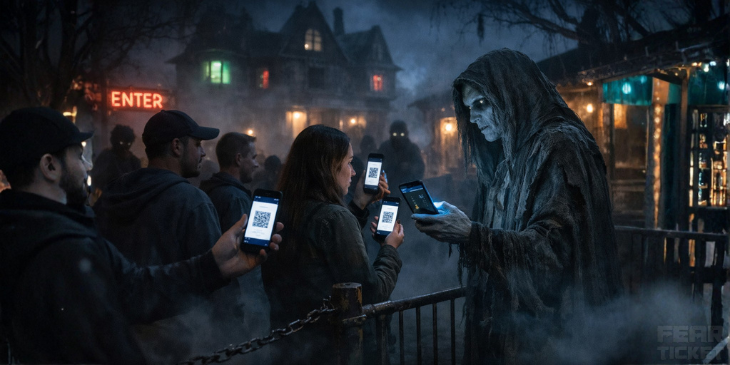
Additionally, contactless ticketing solutions speed up the intake process. Guests simply scan a QR code from their phone at a kiosk or with a staff member’s handheld device. This reduces friction at the gate, keeps lines moving, and provides a safer, more hygienic entry process, a feature that has become standard expectation post-pandemic.
AI Marketing: Beyond Basic Email Blasts
Marketing a haunted attraction requires reaching the right people at the right time. A standard event marketing strategy might involve billboards, radio spots, and generic social media posts. However, AI in ticketing systems allows for hyper-personalized marketing campaigns that convert at a much higher rate.
When a customer buys a ticket through your online event ticketing portal, the AI captures valuable data. It knows where they live, when they buy, how many tickets they purchase, and whether they buy add-ons like fast passes or merchandise.
Using this data, the system can segment your audience automatically. You can send targeted emails to “VIP tickets” or “early-bird tickets” offering them exclusive early access to tickets. You can target “last-minute buyers” with SMS notifications about remaining slots for the upcoming weekend.
Enhancing Security and Safety with AI
Safety is paramount in the haunt industry. Managing thousands of people in dark, disorienting environments carries inherent risks. An intelligent attraction ticketing system contributes to safety through better capacity management.
Crowd management software ensures you never exceed your venue’s safe capacity. The system tracks entries and exits in real-time, giving you an exact count of how many people are on the property at any given moment. If you approach capacity, the booking system features can automatically pause ticket sales or delay entry times until the crowd thins out.
Beyond simple counting, some advanced systems integrate with security cameras to monitor crowd density in specific areas. If a bottleneck forms near the concession stand or the entrance to a specific maze, the system can alert operations managers to deploy staff to clear the congestion. This proactive approach to crowd control prevents potential safety hazards and ensures a smoother flow of traffic throughout the event.
The Role of Contactless and Self-Service Solutions
The modern consumer values speed and autonomy. Contactless ticketing solutions meet this need by empowering guests to manage their own experience. Self-service kiosks, powered by robust booking software, allow walk-up customers to buy tickets without waiting for a cashier. This reduces the need for box office staff and speeds up the transaction process.
For pre-booked guests, the check-in process is seamless. AI-driven scanners can validate tickets instantly, even in low-light conditions typical of haunted attractions. These scanners can also detect fraudulent or duplicate tickets immediately, protecting your revenue.
Moreover, these platforms often include features for waivers. Haunts often require liability waivers, and collecting paper signatures is a logistical nightmare. Integrated digital waivers allow guests to sign on their phones before they arrive. The ticketing system links the signed waiver to the ticket QR code, so a single scan at the gate verifies both payment and legal compliance.
Choosing the Right Haunt Ticketing Platform
With so many options available, selecting the right haunt ticketing platform is a significant decision. It is not just about finding the cheapest service fee; it is about finding a partner that offers the specific ticketing system features you need to grow.
When evaluating potential partners, look for AI in ticketing systems. Ask specifically about their capabilities regarding dynamic pricing AI and predictive analytics for ticket sales. Do they offer true queue management technology or just a simple ticket scanner? Can their event marketing tools integrate with your social media accounts and email providers?
A robust attraction ticketing system should be user-friendly for both your staff and your customers. The backend dashboard should be intuitive, providing real-time data visualization that allows you to make quick decisions. The customer-facing purchase flow must be mobile-optimized, as most online event ticket sales now happen on smartphones.
The Future of AI Haunted Houses and Immersive Tech
As we look forward, the intersection of artificial intelligence Halloween concepts and operations will only deepen. We are beginning to see the concept of an AI haunted house where the scares themselves are responsive.
Imagine a haunt where sensors track a guest’s heart rate or facial expression. This data could be fed into a central system that adjusts the intensity of the animatronics or lighting effects in real-time. If a group seems unimpressed, the system ramps up the intensity. If a guest is too terrified, it dials it back slightly to ensure safety.
While this level of integration is still on the horizon for most, the foundation for it lies in the data collected by your ticketing system. The more you know about your guests, their demographics, their preferences, their spending habits, the more you can tailor the experience.
We are also seeing the rise of AI Halloween art in promotional materials. Generative AI can create hyper-realistic or stylistically unique imagery for posters and websites, allowing smaller haunts to present a big-budget image. This democratization of high-quality creative assets helps level the playing field, making effective event marketing accessible to haunts of all sizes.
Operational Efficiency and Staff Management
Running a haunt involves managing a large, often temporary, workforce. Your booking software can play a surprising role here as well. By analysing peak entry times through predictive analytics for ticket sales, you can optimize your staff schedules.
Instead of having a full crew standing around during a slow Tuesday opening, you can schedule a skeleton crew and bring in reinforcements only when the data predicts a rush. This reduces labour costs significantly without compromising the guest experience.
Furthermore, an integrated event booking system can help track volunteer hours or actor performance. If you scan actors in and out, you have precise records for payroll or incentives. Some platforms even allow for guest feedback mechanisms linked to specific time slots, helping you identify which cast members were working when guest satisfaction was highest.
Final Thought: Embracing the Digital Transformation
The haunted attraction industry is built on tradition, but its future relies on innovation. The days of cash boxes and roll tickets are fading, replaced by the efficiency and intelligence of the AI ticketing platform.
By adopting a modern haunt ticketing platform, you gain more than just a way to process payments. You gain a suite of powerful tools: dynamic pricing AI to maximize revenue, predictive analytics for ticket sales to forecast demand, and queue management technology to improve guest satisfaction. You gain the ability to execute sophisticated event marketing campaigns that reach the right audience at the right time.
For haunt owners and event organizers, the message is clear. To survive and thrive in an increasingly competitive market, you must embrace technology. The event booking system you choose is the engine of your business. Ensure it has the horsepower, and the intelligence, to drive you toward your most successful season yet.
The integration of AI in ticketing systems provides the data-driven insights necessary to turn a seasonal passion project into an optimized, profitable enterprise. As online event ticketing continues to evolve, those who leverage these advanced booking system features will be the ones who not only scare the most guests but also secure the most success. Don’t let your operations be the scariest part of your haunted house. Upgrade to an intelligent solution and focus on what you do best: delivering the ultimate Halloween thrill.