
Contents
- 1 Build Your Search Foundation Months Before Halloween Season
- 2 Launch a Halfway to Halloween Campaign That Generates Real Buzz
- 3 Group Sales: The Fastest Path to a Sold-Out Season
- 4 Social Media Strategy: Build Momentum All Summer Long
- 5 Email Marketing: Most Efficient Marketing Source
- 6 Pricing Strategy: Use Time-Based Urgency to Drive Early Sales
Most haunted house owners make the same costly mistake every year: they wait until September to start marketing. By then, competing attractions have already captured early-bird audiences, locked in group bookings, and built algorithmic momentum on search engines and social platforms. If you want to sell out your haunted house before October even begins, your strategy needs to start now, right at the halfway point to Halloween.
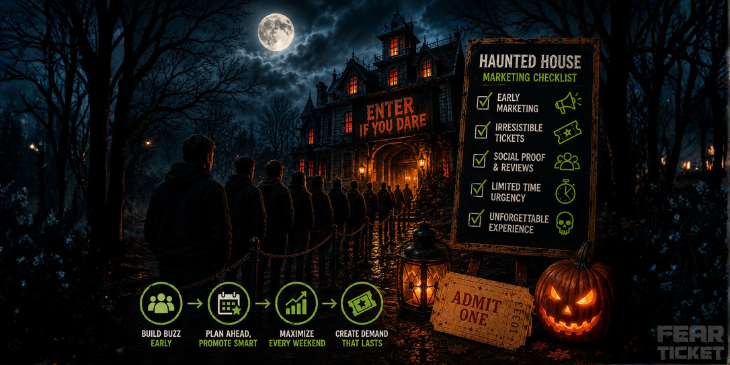
May 1st marks exactly 183 days to Halloween, making it the ideal launching pad for a “Halfway to Halloween” campaign. This window is your golden opportunity to generate buzz, capture email subscribers, sell discounted early-bird tickets, and build the kind of online visibility that takes months to fully ripen in search rankings. Haunt attraction operators who manage this mid-year milestone as an important promotion event consistently outperform those who don’t, in both ticket revenue and sold-out event.
This guide covers everything you need to know to execute a powerful Halfway to Halloween strategy: from SEO groundwork and social media campaigns to group sales outreach and email marketing. Whether you run a large commercial haunted attraction or a community-driven Halloween event, these tactics are designed to fill your queue before the leaves even start to change.
Build Your Search Foundation Months Before Halloween Season
Search engine optimization for haunted house attractions is not a last-minute task. Google’s algorithm needs time to crawl, index, and evaluate your content before rewarding it with strong rankings. If you publish blog posts, landing pages, and updated web content in April and May, you have a legitimate shot at ranking on page one by the time October searches spike, which typically begins in late August.
High-priority SEO actions to take now
Start by auditing your website for technical issues: broken links, slow page load times, missing meta descriptions, and non-mobile-friendly layouts are all ranking killers. Next, build out location-specific landing pages targeting phrases like “haunted house near [city],” “best haunted attractions in [state],” and “scary Halloween events [region] 2025.” These geo-targeted pages are among the highest-converting assets a haunted attraction can have.
Your Google Business Profile is equally critical. Update your hours, add fresh photos, respond to past reviews, and post a Halfway to Halloween announcement using the Posts feature. Local SEO for haunted houses is heavily influenced by Google Business signals — an optimized profile directly impacts how often you appear in map pack results when people search “haunted house near me.”
Finally, pursue backlinks now. Reach out to local event guides, regional tourism websites, Halloween enthusiast blogs, and “things to do in [city]” directories. A handful of strong inbound links built over the summer will significantly boost your domain authority heading into peak season.
Launch a Halfway to Halloween Campaign That Generates Real Buzz
The Halfway to Halloween concept has genuine cultural traction, horror fans, Halloween enthusiasts, and “spooky season” communities celebrate it organically every year. Savvy haunted house operators can tap into this built-in excitement by treating April 30th as a mini-launch event.
Here’s a proven campaign framework to execute around this date:
purchases months before your season opens. Position it as a reward for your most dedicated fans.
Reveal Teasers: Use this moment to drop your first hints about this year’s themes, new scare zones, or attraction upgrades. A cryptic social post, a short behind-the-scenes Reel, or a “coming soon” email is enough to generate engagement without giving everything away.
Giveaway and Contest: Run a social media contest, “tag a friend you’d drag to our haunted house” or “share your scariest Halloween memory for a chance to get a free ticket.” User-generated content can greatly expand your organic visibility, even without paid promotion.
Email List Growth Push: Gate a special piece of content, a “Top 10 Scariest Things to Expect This Year” PDF or a “survival guide” for first-time visitors, behind an email opt-in. Every subscriber you capture in April is a warm lead you can nurture through the summer.
Group Sales: The Fastest Path to a Sold-Out Season
Corporate, School, and Community Groups Book Early — Reach Them Now
Group tickets are the most efficient way to drive large-volume bookings, and groups plan ahead. Corporate team outing organizers, school event coordinators, youth group leaders, and party planners are actively looking for October event options as early as spring. If your haunted attraction isn’t in front of them by May, a competitor will be.
Develop a dedicated group sales page on your website optimized for searches like “haunted house group discount,” “corporate Halloween event [city],” and “haunted attraction private buyout.” This page should clearly list group minimums, pricing tiers, booking process, and any exclusive perks like private entry windows or meet-and-greet experiences with your scare actors.
Reach out directly to HR departments, event coordinators at large local employers, and community organizations via email or LinkedIn. A short, personalized pitch with a group discount offers and easy booking link goes a long way. Many groups will book on the spot when the offer is convenient and the value is clear.
Social Media Strategy: Build Momentum All Summer Long
Haunt Your Followers’ Feeds Long Before October
Haunted house social media doesn’t have to hibernate between November and September. A consistent, creative content calendar that runs from April through October keeps your brand top of mind and builds an engaged community that converts to ticket buyers when the season opens.
Content pillars that work year-round for haunted attractions:
“Behind the scare” content performs exceptionally well, prop building, costume construction, set design walkthroughs, and makeup tutorials satisfy audience curiosity and humanize your team. This type of content earns strong organic reach because it’s genuinely interesting and shareable even for people who don’t live nearby.
Countdown content creates anticipation. A weekly “Days Until Halloween” post featuring a different scare actor, themed quiz, or horror movie recommendation keeps followers engaged through the long off-season gap.
TikTok and Instagram are the key platforms for haunted attractions at present time. Short-form video of dramatic scares, actor transformations, or “if you’re brave enough” challenge formats consistently achieve viral reach in the horror and Halloween niche. Post consistently, three to five times per week, and prioritize video content above static posts.
Paid social retargeting should begin by August at the latest. Build a custom audience of website visitors, email subscribers, and video viewers and serve them ticket-purchase ads as October approaches.
Email Marketing: Most Efficient Marketing Source
Nurture Subscribers from April to Opening Night
Email remains the highest-ROI marketing channel for event-based businesses. A haunted house with a list of 5,000 engaged subscribers has a direct line to ticket sales that no algorithm change can interrupt. Start building — or re-engaging — your list now.
A summer email nurture sequence for haunted attractions:
Send a Halfway to Halloween announcement email first, featuring your early-bird offer and a teaser of what’s new this year. Follow up with monthly “countdown” emails through the summer that reveal a new theme, introduce a scare zone, or spotlight a team member. As September arrives, shift to a higher cadence, weekly emails, with urgency messaging around limited date availability, group booking cutoffs, and sold-out warnings for peak nights.
Pricing Strategy: Use Time-Based Urgency to Drive Early Sales
Tiered Pricing Rewards Early Buyers and Creates Selling Pressure
Dynamic pricing, where ticketing prices increase as the season approaches and inventory fills, is one of the most effective revenue optimization strategies for haunted attractions. When buyers know prices go up over time, early purchase becomes the rational choice.
A typical tiered pricing structure might look like this: deepest discount available during Halfway to Halloween in late April, a moderate discount through June and July, standard pricing in August and September, and premium pricing for peak October dates (weekends, the week of Halloween). This structure rewards your most enthusiastic fans, generates cash flow in the slow season, and creates organic urgency without relying on false scarcity.
Final Thoughts
The haunted attraction industry is more competitive than ever. Standing out requires more than great scares, it requires smart, early, and sustained marketing. By launching your Halfway to Halloween strategy now, you’re giving your SEO content months to mature, your email list months to grow, your group sales pipeline months to close, and your social community months to build genuine excitement.
FAQs
Is it worth marketing a haunted house in April isn’t that too early?
Absolutely worth it. SEO results require months of lead time, group buyers plan ahead, and early-bird ticket campaigns generate off-season cash flow while building an engaged audience. The haunted attractions that consistently sell out by mid-October almost universally begin their marketing in spring.
What is a “Halfway to Halloween” campaign and how do I use it?
Halfway to Halloween falls around April 30th – exactly six months before October 31st. It’s a recognized moment in the horror and Halloween community. You can use it as a themed launch event for early-bird ticket sales, a social media marketing campaign, a reveal of your season’s themes, or a combination of all three.
How much of a discount should I offer for early-bird haunted house tickets?
A discount between 20% and 35% is typically compelling enough to drive purchases without significantly eroding your revenue. Pair the discount with a hard deadline and limited quantity cap to maximize urgency. Frame it as an exclusive reward for your most loyal fans rather than a general sale.
How do I get haunted house groups bookings?
Create a dedicated group sales page on your website, optimize it for relevant search terms, and actively reach out to HR departments, corporate event planners, school activity coordinators, and community organizations via email and LinkedIn. Offer clear group pricing tiers, easy booking, and perks like reserved entry or private windows. Start outreach in April and May, groups plan months in advance.
What social media platforms work best for haunted house marketing?
TikTok and Instagram Reels are the highest-reach platforms for haunted attractions, especially for behind-the-scenes and scare content. Facebook remains valuable for reaching older audiences and running targeted paid ad campaigns. YouTube is excellent for longer walk-through videos that rank in search. Weight reel content across all social media platforms.
When should I start running paid ads for my haunted house?
Begin building retargeting audiences (website visitors, email subscribers, video viewers) immediately. Launch brand awareness campaigns in July or August and shift to hard ticket-sale conversion campaigns in September. Paid social and Google Ads for haunted houses peak in September and October, so starting your pixel and audience warm-up earlier gives you a significant advantage.
How can I get local press coverage for my haunted house?
Pitch local news stations, lifestyle blogs, and event guides with a compelling story angle, your Halfway to Halloween campaign, a unique new feature this year, a charity partnership, or a record you’re attempting. Send personalized pitches in August for best placement timing before October coverage gets competitive.