
Contents
- 1 The Challenge of Peak Volume in October
- 2 Building a Foundation with a Haunted House Timed Entry System
- 3 Mastering Haunted Attraction Crowd Management at the Gate
- 4 Learning How to Manage Haunted House Lines
- 5 Leveraging Modern Haunt Ticketing for Speed
- 6 Upgrading Your Entire Ticketing System
- 7 Elevating Haunted House Ticketing Beyond the Gate
- 8 Essential Ticketing Features to Keep Lines Moving
- 9 Implementing Proven Halloween Event Crowd Control Tips
- 10 Inside the Attraction: Actionable Haunted House Guest Flow Tips
- 11 The Role of Haunted Attraction Operations Management in Crisis
- 12 Scaling Your Haunt with FEARTICKET
October weekends bring an absolute flood of thrill-seekers to your venue. The parking lots fill up instantly, the front gates get slammed, and eager guests arrive in massive waves expecting to be terrified. If your team lacks a solid plan to process these massive crowds, that sudden influx creates severe bottlenecks that ruin the experience. Long, stagnant waits kill the suspense, frustrate your paying customers, and place immense stress on your seasonal staff.
You must take proactive steps to keep people moving seamlessly from the parking lot to the final exit door. Excellent operations separate a chaotic, miserable night from a highly profitable, smooth-running production. When you control the pace of arrivals and movement perfectly, you preserve the scare factor while safely maximizing your nightly throughput.
In this guide, you will learn exactly how top-tier events manage high-volume nights and eliminate dead zones inside their venues. We will cover the specific software tools, physical layout adjustments, and staffing strategies that prevent the dreaded front-gate crunch. By partnering with ticketing platforms like FEARTICKET, you can leverage advanced technology to handle your busiest nights with complete confidence.
The Challenge of Peak Volume in October
Every scream park operator knows the brutal struggle of the middle weekends in October. Demand skyrockets unexpectedly, and everyone wants to arrive right at prime time on Friday and Saturday nights. This creates a massive imbalance between your actual hourly capacity and the number of people standing at your front gate. When your throughput cannot match the arrival rate, the physical queue grows exponentially.
Guests standing in a stagnant line for over two hours quickly lose their enthusiasm for your show. They become tired, agitated, and much harder for your actors to scare once they finally enter the attraction. Furthermore, massive physical lines require significantly more staff to monitor and manage, pulling your valuable resources away from other important areas of your event.
Effective haunted attraction crowd management requires you to address this volume problem before guests even leave their homes. You must shape guest behaviour, spread out arrival times, and use your physical space smartly. When you handle haunted attraction crowd management correctly, guests spend much less time waiting and more time enjoying the terrifying experience you built.
Building a Foundation with a Haunted House Timed Entry System
Moving away from general admission is the single biggest operational upgrade you can make for your venue. Implementing a haunted house timed entry system completely changes how guests interact with your event. Instead of showing up whenever they want and forming a massive mob, guests purchase tickets for specific thirty-minute or one-hour arrival windows.
A haunted house timed entry system flattens the curve of your nightly arrivals. If your safe hourly capacity is five hundred people, you only sell five hundred tickets for the 8:00 PM time slot. This completely prevents the massive spikes in attendance that overwhelm your security team, box office staff, and queue lines.
Guests absolutely love this approach because it respects their valuable time. They can plan their evening better, knowing they will not face a three-hour wait immediately upon arrival. For operators, utilizing a haunted house timed entry system provides predictable revenue and allows you to schedule your event staff more efficiently based on exact attendance numbers.
Mastering Haunted Attraction Crowd Management at the Gate
The foundation of excellent crowd control starts with understanding your actual hourly throughput limit. You must know exactly how many people can safely walk through your attraction every sixty minutes without causing a traffic jam inside. Once you know this specific number, you can build your entire operational strategy around it.
Do not rely on guessing or past assumptions to determine this critical metric. Run timing tests with your staff walking at a normal pace to see exactly how long the journey takes from start to finish. Factor in the natural pauses caused by scare actors, narrow hallways, and dark transition zones. This accurate data allows you to set realistic expectations for your front gate dispatch team.
When you master haunted attraction crowd management, you prevent the dreaded “conga line” effect. This happens when groups catch up to one another inside the maze, ruining the scares for everyone except the person at the very front. Pacing your dispatch based on your true capacity keeps groups separated and preserves the integrity of your show.
Learning How to Manage Haunted House Lines
Understanding how to manage haunted house lines physically is just as important as managing them digitally through software. You must design your queue space to keep people entertained and constantly moving forward. A boring, stagnant line is the absolute quickest way to lower your overall guest satisfaction scores.
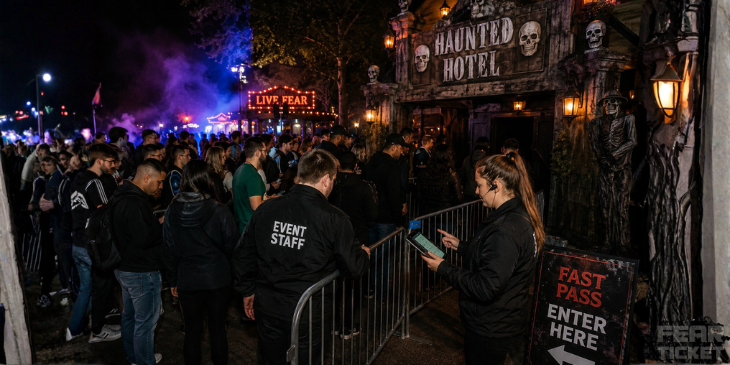
One of the best ways to improve the waiting experience is to introduce roaming scare actors into your queue lines. This keeps guests engaged, distracts them from the wait, and sets the tone for the main event. It also serves a practical purpose, as sudden scares often cause groups to compress, making the line feel like it is moving much faster than it actually is.
Another crucial strategy for how to manage haunted house lines is clear, consistent communication. Use digital signage or audio announcements to give guests accurate wait time estimates. When people know exactly how long they will wait, their anxiety drops significantly, and they complain much less.
You must also consider the physical layout of your queue. Narrow switchbacks can make guests feel trapped and claustrophobic before they even enter the attraction. Widen your queue lanes to give people breathing room, which is a fundamental aspect of knowing how to manage haunted house lines effectively on busy nights.
Leveraging Modern Haunt Ticketing for Speed
Your front gate is the very first major interaction guests have with your business. If your haunt ticketing process is slow, confusing, or broken, the entire night gets off to a terrible start. You need a setup that allows for lightning-fast scanning and validation so guests can move directly into the holding area.
Modern haunt ticketing requires robust, specialized software that handles high-volume transactions without freezing or crashing. You simply cannot afford for your scanners to go offline right at 9:00 PM on the busiest Saturday of the season. Platforms like FEARTICKET are built specifically for this industry, ensuring your hardware works perfectly even in low-light conditions.
Focus on pushing advance online sales as much as possible to improve your haunt ticketing flow. Every single ticket bought online is one less transaction taking up valuable time at your physical box office window. Offer slight discounts for buying ahead of time to incentivize this behaviour, drastically reducing the physical bottleneck at your entrance.
Upgrading Your Entire Ticketing System
Choosing the right technology partner changes everything for your October operations. A reliable ticketing system does much more than just process credit cards; it acts as the central hub for your entire business. It should give you real-time data on how many people have entered, how many are still expected, and where your online sales are coming from.
Your chosen ticketing system must be incredibly easy for your seasonal staff to learn and operate under pressure. High turnover is very common in the seasonal attraction industry, so you cannot spend weeks training someone on a complicated box office interface. Look for intuitive designs that allow a brand-new hire to start scanning guests confidently within five minutes of training.
Furthermore, a truly great ticketing system will offer offline scanning capabilities. Internet connections at outdoor farms or rural warehouse districts can be highly unpredictable. If your Wi-Fi drops completely, your staff must still be able to scan barcodes and keep the line moving without missing a single beat.
Elevating Haunted House Ticketing Beyond the Gate
Many operators view ticket sales purely as a simple revenue collection mechanism. However, intelligent haunted house ticketing is a powerful crowd control tool. By adjusting your prices dynamically based on demand, you can steer guests away from your busiest nights and toward your slower operational days.
Effective haunted house ticketing uses variable pricing to balance the customer load perfectly. Charge a premium for Saturday nights in late October and offer significant discounts for Thursday or Sunday nights early in the season. Cost-conscious consumers will naturally shift to the cheaper nights, instantly relieving the immense pressure on your peak operational hours.
You can also use strategic haunted house ticketing to offer premium queue-jumping upgrades. VIP passes or fast-pass or an early bird ticketing options generate massive revenue while giving guests a choice in how they experience your event. Keep the VIP ratio strictly managed so it never negatively impacts the general admission flow too severely.
Essential Ticketing Features to Keep Lines Moving
When evaluating your software options, you need to look for specific tools that solve your biggest operational headaches. Certain ticketing features directly impact how fast you can process crowds at the gate. For example, mobile tickets delivery via SMS ensures guests have their barcodes open and ready before they even reach the scanner.
One of the most important ticketing features is the ability to easily upgrade or alter tickets on the fly. If a guest arrives late for their time slot, your box office staff needs a simple way to bump them to the next available window without holding up the line. Complex software that requires ten clicks to change a time slot will create massive delays.
Another critical inclusion among necessary ticketing features is robust reporting and analytics. You need to pull detailed reports at the end of the night showing arrival patterns, scan rates per employee, and capacity fulfilment. This data allows you to tweak your operations for the following weekend, making continuous improvements to your guest flow.
Implementing Proven Halloween Event Crowd Control Tips
Crowd control goes far beyond just managing lines; it is about directing human traffic throughout your entire footprint. One of the best Halloween event crowd control tips is to physically widen your main walkways. Narrow paths cause guests to bump into each other, slowing down movement and creating unnecessary friction in the dark.
Another highly effective strategy from top Halloween event crowd control tips is creating physical barriers to guide movement. Use heavy-duty stanchions, custom fencing, or even heavy hay bales to clearly define exactly where people should walk. Left to their own devices, large crowds will wander and create chaos, so you must dictate their path clearly.
Always ensure you have clearly marked; well-built exits completely separate from your entrance paths. Cross-traffic is the absolute enemy of good flow. Following the best Halloween event crowd control tips means people leaving the attraction should never have to push through the crowd of people waiting to get in.
Inside the Attraction: Actionable Haunted House Guest Flow Tips
Once inside the actual attraction, maintaining a steady pace is absolutely vital. Among the most critical haunted house guest flow tips is training your scare actors to actively push the crowd forward. Actors should deliver their scares from the side or behind, startling guests in a way that makes them hurry down the hallway rather than backing up.
A massive element of these haunted house guest flow tips involves eliminating all physical dead ends. your maze layout forces people to stop, turn around, and find a different route, you will instantly cause a massive backup. Design your path to be completely intuitive so guests naturally flow from one room to the next without thinking about it.
Use lighting and sound to subtly guide your visitors through the darkness. People naturally walk toward illuminated areas and shy away from complete darkness. By applying these haunted house guest flow tips and placing a subtle spotlight on the exit door of a room, you unconsciously pull the group forward, keeping your throughput steady.
The Role of Haunted Attraction Operations Management in Crisis
To tie all these strategies together, you need strong, experienced leadership on the ground. Excellent haunted attraction operations management requires a dedicated person constantly monitoring the big picture. This manager should not be taking tickets or acting in a room; they must be totally free to observe the flow and fix problems before they escalate.
Strong haunted attraction operations management involves constant, clear communication via two-way radios. Your box office, your queue line staff, and your internal security team must be talking to each other constantly. If the internal maze backs up, the manager must immediately radio the front gate to slow down the dispatch rate until the jam clears.
After every single night of operation, proper haunted attraction operations management dictates that you hold a brief debrief with your core team. Discuss what went right, where the lines got stuck, and how the technology performed. Adjust your plans based on this feedback to ensure the next peak night runs even smoother.
Scaling Your Haunt with FEARTICKET
Managing large crowds on peak October nights requires a perfect blend of smart technology, strategic layout design, and highly trained staff. By controlling arrival patterns and keeping physical lines moving, you protect the high-quality experience your guests expect and demand. You cannot achieve this level of efficiency without the right ticketing partner by your side.
FEARTICKET provides the ultimate solution for managing your front gate operations. Our specialized platform includes all the advanced ticketing features you need to process guests quickly and eliminate long wait times. From seamless mobile scanning to dynamic pricing tools, we help you take total control over your nightly throughput.
Deliver a seamless experience on peak nights for your staff and every customer. Implement a robust ticketing system that supports timed entry, fast scanning, and detailed reporting. Partner with FEARTICKET today to transform your guest flow, boost your revenue, and deliver the best possible scares all season long.
FAQs
1. What is the most effective approach to haunted attraction crowd management?
The best approach is to stop massive crowds from forming at the gate by using scheduled arrival windows. Pair this strategy with an intuitive physical layout, well-trained staff, and clear signage to keep guests moving smoothly throughout your entire property without confusion.
2. How does a haunted house timed entry system reduce wait times?
This system restricts the number of tickets sold for each specific hour of the night. By matching ticket sales directly to your maximum hourly capacity, you prevent massive, unexpected spikes in arrivals, dramatically reducing the physical queue at the front gate.
3. What are the best haunted house guest flow tips for inside the maze?
Train your scare actors to startle guests forward rather than blocking their forward path. Additionally, use strategic lighting to naturally guide visitors toward the next room, and design your maze layout to eliminate confusing dead ends or tight corners that force groups to stop.
4. Which Halloween event crowd control tips help manage the parking lot and entrance?
Implement a strictly controlled one-way traffic pattern for both vehicles and pedestrians to eliminate cross-traffic conflicts and reduce congestion. Clearly mark your entrance paths with heavy-duty barricades and deploy staff to the parking area to direct guests exactly where to park and walk upon arrival.